'/> Amazing Animals

Monday, November 7, 2011

10 Extremes Animals Whose Names Begin with The Letter O

From a tiny tick-eating African bird, to a weird forest giraffe and to an endangered big-eared bat, the animal kingdom presents us with 10 extreme animals whose names begin with the letter O.

Oxpecker

photo link

The oxpeckers, also known as tickbirds, are two species of bird of the genus Buphagus. Widespread to sub-Saharan Africa, the two species namely: Red-billed Oxpecker and Yellow-billed Oxpecker are characterized by their broad bills, short legs and sharp claws. Also, both species sport brown plumage and average about 23 cm long. Found mostly in open habitats, oxpeckers hunt in the group on the back of the host animal feeding on ticks, dandruff, fleas, flies and ear wax. Using their bills, they open new wounds consuming the fresh tissues and drinking the blood.

Olingo

photo link

Olingo (Bassaricyon gabbii) are six species of solitary mammals endemic to the rainforests of Ecuador, Peru, Columbia, Venezuela, Panama, Paraguay, Costa Rica, Nicaragua and Honduras. This arboreal and nocturnal animal can grow to about 35 to 48 cm long and weigh 10 to 15 kg. The tail can measure up to 48 cm. It sports a light brown coat with short fur, round head, rounded ears, pointed muzzle, sharp curved claws, and sharp teeth. The Olingo’s main food source includes: insects, lizards, and fruits.

Opossum

photo link

Opossums (Didelphimorphia), often called possums, are 60-plus species of small to medium-sized marsupials widespread in the Western Hemisphere. These excellent tree climbers average 76 cm long from nose to tail, and weigh between 4 to 6 kg. Opossums are omnivores, feeding on mice, snakes, birds, insects and at times eat fruits, nuts and grass. A very slow runner, an opossum when cornered by its predator usually “play possum”, mimicking a dead animal by lying motionless on the ground, eyes closed and its ear extended until such time a change to make an escape comes.

Okapi

photo link

Okapi (Okapia johnstoni) is a giraffe-like mammal endemic found in rainforests of Upper Zaire and the Democratic Republic of Congo. Adults stand to about 150-170 cm at shoulder length, 210 cm in body length, weigh around 210-250 kg and with an average of 30-42 cm tall. It has deep reddish-brown coat and a distinctive zebra-like stripes on its upper legs and hindquarters. Built more like a zebra, the okapi has a horse-like head, thick neck with black muzzle, large ears and a prehensile tongue. This long, sticky black/blue tongue measuring about 30 cm is used to strip leaves, to clean its ears and to wash its eyelids. Lifespan in captivity is about 30 years.

Otter

photo link

Otters are twelve species in seven genera of semi-aquatic mammals comprising the family Mustelidae. They inhabit temperate regions of Europe, Asia, North America, and parts of North Africa. These playful mammals sport long, slender bodies, short limbs, muscular tails, sharp claws, and webbed paws. Otters average 0.7 to 1.8 m long and weigh 5 50 45 kg. Its diet includes fish and shellfish, amphibians, birds, small animals and other invertebrates.

Onager

photo link

The Onagers (Equus hemionus), also known as: Asian Wild Ass are five species of wild horses endemic to India, Iran, Israel, Syria, Pakistan and Tibet. Smaller than horses, but larger than donkeys, onagers sport muscular bodies, buff/brown coat, with a white underside, dorsal stripes and dark mane. Though short-legged, they are extremely fast and agile. Adults can reach up to 2.1 meters in length, and weigh 200 – 250 kg. It feeds primarily on grasses and tender plants.

Oropendola

photo link

Oropendolas (genus Psarocolius) are large blackbirds comprising the family (Icteridae) widespread in South and Central America. Generally, these passerine birds have chestnut, dark brown, chestnut or black plumage, long yellow tails, black legs, and pointed beaks. These colonial breeders typically inhabit forests, and open woodlands. Adult males, which are 50% larger than females average 30–50 cm long. Oropendolas feeds on fruits and large insects.

Oryx

photo link

The Oryx is a large antelope native to near-desert regions of Africa and the Arabian Peninsula. It measures about 1.5 m at shoulder length, 1.5 – 2.3 meters long and can weigh up to 200 kg. It has a muscular body, curved horns, and a thick neck with short mane. The coat is fawn in color with distinguished black marking running down its legs. It feeds primarily on coarse grasses, roots and tubers.

Ozark big-eared bat

photo link

The Ozark big-eared bat (Corynorhinus townsendii ingens) is a medium-sized bat found only in several caves in Missouri, Arkansas, Missouri, and Oklahoma. An endangered species, this bat is about 10 cm long and weighs from5-13 g. It has large, erect ears about 2.5 cm, lump-adorned snout, and large wingspan reaching 30 to 34 centimeters. The Ozark big-eared bat diet includes moths, and other small bugs.

Ovenbird

photo link

The Ovenbird (Seiurus aurocapillus), is a small, inconspicuous migratory bird of North America. Adult measures around 14 cm long and weigh about 18 g. It sports olive-brown plumage with white belly mark with black streak. Eyes are surrounded with white rings, and a crown of orange feathers on its head. The ovenbird forage on the forest floor in search for foods which includes insects, spiders and small invertebrates.

Check out the entire Animal Alphabet list here:
Amazing Animal Alphabet Series 1
Amazing Animal Alphabet Series 2

Thursday, November 3, 2011

The Carnivores: The World's Most Fearless yet Graceful Animals – Part One

Carnivores are considered the most fearless and ferocious creatures that humans have ever known. They have the built, power and stamina to lord it over hapless prey. These killing machines are gifted with special sensors, including an acute sense of smell, greater eye vision and ferocious teeth that comes in very handy for the kill. And they are blessed with swift, and graceful moves, adding to their predatory skills. Read on to learn more about these carnivores.

Generally, carnivores, whether they are mammals, reptiles, insects or birds are meat-eaters. We will focus on a specific type of mammal that comprises the order Carnivora --which human deemed fascinating creatures.

photo link

Built to Hunt

These carnivores are bunched together, for they all share a common characteristic --they strive for meat. However, not all of them are considered highly or specialized predators. For example, the giant panda is considered herbivore for it feeds on bamboo shoots. Bears and badgers are omnivores since they will eat anything edible. Nevertheless, these animals shared common features with true predators, thus are included in the same group as that of the carnivores. Shapes and sizes don't matter, true carnivores share certain basic characteristics.

photo link

Almost all carnivores share similar tooth structure. On each side of its top and bottom jaw, true carnivore has a prominent canine tooth, three incisor teeth, four small premolar teeth used for grinding, and three molars.In general, the pointed teeth (canine) are larger and much developed that the cutting teeth (incisor.) Canine teeth are very important weapons for they act as fangs to pierce the main arteries of the prey.

photo link

The smaller grinding teeth (molars) looking like sharp, blade-like stuffs function as meat cutter or a slicer. The meat must be cut into chewable chunks for these hunting machines are incapable of chewing their meal into a pulp because their jaws can only move up and down, plus the fact that they have small grinding teeth. The tongue specially that of cats are equipped with horny, backward-facing tooth-like bumps.

Built for Speed

photo link

Mobility and speed is a must for carnivores! In their case, a skeleton with very restricted features is in place. A large collar bone for instance, can impede its body mobility, thus true carnivore has small collarbone or in some species physically absent. Carnivores typically differ in how they move or walk. There are two main types: the plantigrade species and the digitigrade species. Plantigrade -type of carnivores stamp the soles of their feet on the ground when walking, while the digitigrade-type ones walk on their toes. Digitigrades are better adapted for running.

photo link

A Sense of Survival

It is very important for carnivores have good sense of sight, hearing and smell in order to survive in the wild. However, the need for these senses differ from animal to animal.

photo link

Most of these meat-seekers hunt by night, and a good eyesight that could see prey at some distance is a must. Dogs and cats are adapted to night vision: owing to "taperum" an extra layer of reflective fibrous cells over the retina. These special cells concentrate or redirect, the amount of light that enters the eyes. This is the reason why cat's and dog's eyes glow at night.

photo link

A number of carnivores do their hunting in dense vegetation using the upgraded sense of hearing and smell. The changed is very noticeable in the species ear size and shape. Some species, like the fox, have directional ears, good at pinpointing the sound source in great clarity and accuracy.

photo link

Other body parts aids carnivores to attain a very delicate sense of touch. Raccoons whiskers augment the animals need for a keen sense of smell. Also, these animals have sensitive nerve endings on the soles of their feet.

photo link

For small carnivores like the Coati (Nasua narica) of Central America, having to blend well with its surroundings is very essential for them to survive. The ability to change color (camouflage) will enable the animal to creep up on its prey unseen. Also, it serves as a defense mechanism to escape or free from harm from bigger predators.

photo link

An Individual Identity

Since almost all carnivores are gifted with an acute sense of smell marking out the boundaries of its territory will come in very helpful. These fearless animals emit special and identifiable scents and rub a certain part of its body against any object to mark out the scope of its territory. In some species, these foul-smelling scents serve as a defense mechanism against larger predators. Some species like the skunks and polecats produce these scents through glands in the skin.

photo link

Carnivores hunting style differs from species to species: lions go for ambush, cheetahs go for swift and stealthy pursuits and coyotes leap on prey.

photo link

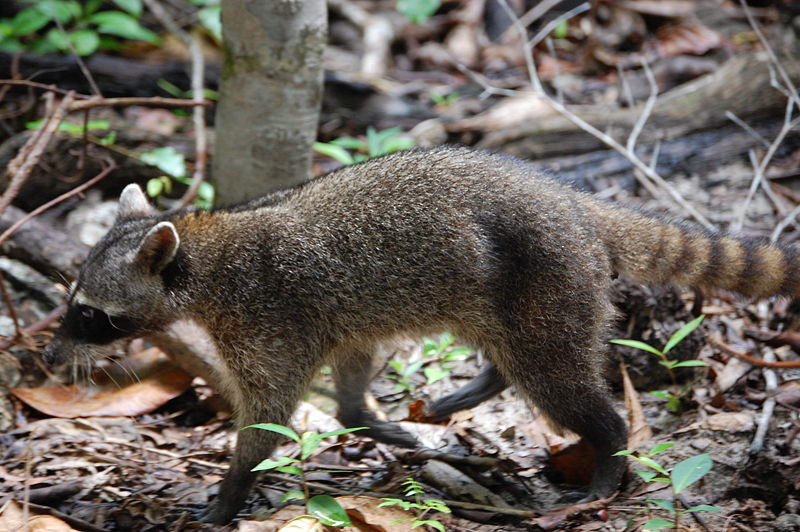
But there is one carnivore species that has the most adaptable hunting skills. The crab - eating raccoon (Procyon cancrivorus) can climb well and swim well in pursuit of its prey. It lives in areas near marshes, rivers and lakes -- makes its home in the trees.

Check out Part 2 here: