'/> Amazing Animals: cheetah
Showing posts with label cheetah. Show all posts

Monday, November 5, 2012

10 Best Animal Moms

If there are good dads, then here are the best animal mums.

Elephant

photo link

Ask every mother what is the hardest part of motherhood and all will be in unison in saying "giving birth is the hardest". How much more if you are to deliver a 90 kilogram baby. It's got to be a hard experience, that’s why our first mum, the female elephant, made it to the list. To add to the pain of giving birth, these mums have to endure the ordeal of a 22-month pregnancy. Baby elephant is born blind so it has to rely on her mother’s trunk for navigation. Since elephants do has a “matriarchal society” rearing a calf is not a problem for these animals. Every adult ladies in the community take turns in baby-sitting for the young ones.

Koala

photo link

We all know that koalas eat only on one thing: eucalyptus leaves (a very poisonous leaves. A female koala is equipped with a special digestive tract can endure this otherwise deadly threat, their bowels contain special bacteria that detoxify the leaves. Newly born koalas or ‘joeys' lack eyes, ears and fur and the ability to detoxify eucalyptus leaves - so they have to rely on their mums care. Koala mothers help their young ones build up their tolerance by feeding them her own feces! For purposes of information, feces are the body’s solid waste matter, composed of undigested food, bacteria, water, and bile pigments and discharged from the bowel through the anus. Joeys stay in their mother's pouch for about six months feeding on milk and forming their missing parts. While caring and nurturing their joeys, mums get about 22 hours of shut-eye a day — that’s nearly 90 percent of her life spent snoozing!

Alligator

photo link

The female alligator has a creative and ingenious way of keeping the temperature on its nest at a constant one by building it; using rotting vegetation that produces heat so it takes from her the burden of sitting on her eggs. A very nice idea, don’t you think so? Even scientists marveled at the way female alligators handled the nest temperature. If the temperature is below 31 degrees Celsius (88 degrees Fahrenheit), it’s a girl and if it tops 33 degrees Celsius (91 degrees Fahrenheit), it’s a boy! Mothers carry their newborns in their jaws for protection as well as watching and aiding them to the water, where they will spend their early years on meals such as: fish, insects, snails and crustaceans.

Polar Bear

photo link

Since male polar bears are known to be 'Macho Gigolo' – master of one -night stand; female polar bears have to suffer for the ‘quickie’ relationship. They have to put on around 180 kg (400 lb) during their pregnancy! So to sustain a normal pregnancy, prospective mums are advised to eat as much food as it could get. The reason is: if they can’t find enough food to double her weight; the poor fetus will be reabsorbed by the body. Isn’t it weird? But the good thing is; female polar bears, if ever they consumed that required diet, will have an easier time delivering the baby. All she would do is to dig a maternity den where she goes into a hibernation-like state, doesn’t eat for two months and also sleeps through the baby’s birth.

Cheetah

photo link

Mother cheetahs have a nice way of rearing up their cubs and it needs a lot of patience. For two years or more, mom has to be always there to teach, guide and protect her cubs in the rigor of daily life. Teaching them how to spot and ambush a prey at the same time protecting them from possible predators. Once the cubs learned the tricks needed to survive the hostile environment, female cheetahs leave their children to fend for themselves and moves on to start a new family.

Orang-utan

photo link

We can call female orangutan as “Mrs. Do-it-all” spending almost 90% of her life high up in the trees, building a new nest every single night. These females nurse their babies the longest amongst animal, taking care of offspring until they reach the age of 6 or 7. Also, female children often stay longer to learn child-rearing skills.

Red-Knobbed Hornbills

photo link

These small birds that are commonly found on the Indonesian island of Sulawesi make holes in trees to serve as their nests. Since monitor lizards crave for their eggs, these wily birds have to design the entryway to their nests with a very special sealant — their own feces. Can you take that? The expectant mother has to stay in the hole for two months to incubate the eggs. In so doing, ignoring hunger pains to her detriment - the smell from her protection method.

Elephant Seal

photo link

A behemoth in terms of size, the female elephant seal can weigh up to 771 kg (1,700 lb). During the pregnancy period that will take an 11-month gestation period, these moms-to-be must have to add weight each day. They don’t believe in slimming process. However, as soon as she gave birth and starts nursing her cubs, she’ll lose about 272 kg (600 lb) in less than a month.

Octopus

photo link

The female octopus doesn’t approve of birth control – she lays more than 50,000 eggs. This mum guard her eggs from predators and giving them fresh oxygen by gently blowing currents of water over them. How long will she do this? It takes 40 days for the eggs to hatch. And during this time, mum-to-be can’t hunt for food so what is her recourse? Well, having eight arms, eating one of them is no big deal. It's better to be live 7-legged octopus than a dead eight-legged creature.

Sea Louse

photo link

Small but terrible, that amply applies to our top list. This small aquatic crustacean has a cunning way of luring male into his bachelor burrow for mating – in the company with 25 other pregnant females! Poor lady, and if that wasn’t bad enough, take note – once the babies are ready to be born, they make their way into the world by eating her from the inside out.

Check out:
Best Animal Dads

Tuesday, February 14, 2012

The 10 Fastest Animals in The World

Some animals possess extraordinary abilities. Some of them move so fast and some are very strong relative to body size. Here are the 10 fastest animals in the world. Here are the 10 world’s quickest and fastest creatures.

Tiger Beetles – World’s Fastest Animals in Terms of Body Size

photo link

Tiger Beetles are among the most amazing animals in the world. They can sprint at 13 km/h. If human beings are like Tiger Beetles, we can run as fast as 494 km/h. They are the fastest animal in the world in equivalent to body size. Tiger Beetles run extremely fast they go blind. Their speed is about 22 times the speed of the fastest human sprinter.

Cone Snails – World’s Fastest Killers

photo link

I know you are surprised to see a snail on the list because we all know for a fact that snails are amongst the slowest animals in the world. Cone Snails are not the fastest in terms of running or moving, but the world’s fastest killers. These poisonous and dangerous creatures hunt, fish, marine worms and mollusks using harpoon-like teeth and poison gland killing their prey almost instantly.

Worms – World’s Fastest Legless Invertebrates

photo link

Don’t get shocked if you have seen a worm in the list of the fastest animals in the world. With a speed of up to 16 m/h through solid ground, Worms are considered the fastest legless invertebrates.

Mantis Shrimps – World’s Fastest Animal Strikers

photo link

Because of their exceptional speed, Mantis Shrimps can beat the best gunslingers in the west with their strike. Don’t go near the hole of these solitary creatures because they will snap you as fast as the bullet.

Basilisks – World’s Fastest Animals on Water Surface

photo link

Basilisks are animals known for their ability to walk or run above the surface of water, hence they have been dubbed as “Jesus Christ Lizards. Their feet move extremely fast that they can run on water at a speed of 5.4 km/h.

Hares – Animals More Than Twice as Fast as Humans

photo link

Do not underestimate Hare because they are extremely fast, they can run twice as fast as an Olympic sprinter. These very fast moving animals, particularly the European Brown Hare, can attain a maximum speed of 72 km/h.

Mako Sharks – World’s Fastest Shark Species

photo link

Mako Sharks, particularly the Shortfin Mako Sharks (Isurus oxyrinchus), are the fastest of all the shark species in the world. It can attain a maximum speed of up to 48 km/h. Their scientific name means “sharp nose”.

Ostriches – World’s Fastest Animals on Two Legs

photo link

Yes, you’ve read it right, Ostriches are the world’s fastest animal on two legs, They can attain a breathtaking speed of up to 97.5 km/h. They are also the largest extant species of bird and lay the largest egg of any extant bird.

Cheetahs – World’s Fastest Land Animals

photo link

Of all the fastest animals in the world, perhaps the most popular is the Cheetah (Acinonyx jubatus). Running at a speed of115 km/h, Cheetahs are the fastest animals on land.

Peregrine Falcons – World’s Fastest Animals

photo link

Peregrine Falcons are the fastest extant member of the animal kingdom. They can dive at an amazing peed of320 km/h. its compound name is Falco peregrines and is also known as the Peregrine. Historically, they are known in North America as the Duck Hawks.

Thursday, November 3, 2011

The Carnivores: The World's Most Fearless yet Graceful Animals – Part One

Carnivores are considered the most fearless and ferocious creatures that humans have ever known. They have the built, power and stamina to lord it over hapless prey. These killing machines are gifted with special sensors, including an acute sense of smell, greater eye vision and ferocious teeth that comes in very handy for the kill. And they are blessed with swift, and graceful moves, adding to their predatory skills. Read on to learn more about these carnivores.

Generally, carnivores, whether they are mammals, reptiles, insects or birds are meat-eaters. We will focus on a specific type of mammal that comprises the order Carnivora --which human deemed fascinating creatures.

photo link

Built to Hunt

These carnivores are bunched together, for they all share a common characteristic --they strive for meat. However, not all of them are considered highly or specialized predators. For example, the giant panda is considered herbivore for it feeds on bamboo shoots. Bears and badgers are omnivores since they will eat anything edible. Nevertheless, these animals shared common features with true predators, thus are included in the same group as that of the carnivores. Shapes and sizes don't matter, true carnivores share certain basic characteristics.

photo link

Almost all carnivores share similar tooth structure. On each side of its top and bottom jaw, true carnivore has a prominent canine tooth, three incisor teeth, four small premolar teeth used for grinding, and three molars.In general, the pointed teeth (canine) are larger and much developed that the cutting teeth (incisor.) Canine teeth are very important weapons for they act as fangs to pierce the main arteries of the prey.

photo link

The smaller grinding teeth (molars) looking like sharp, blade-like stuffs function as meat cutter or a slicer. The meat must be cut into chewable chunks for these hunting machines are incapable of chewing their meal into a pulp because their jaws can only move up and down, plus the fact that they have small grinding teeth. The tongue specially that of cats are equipped with horny, backward-facing tooth-like bumps.

Built for Speed

photo link

Mobility and speed is a must for carnivores! In their case, a skeleton with very restricted features is in place. A large collar bone for instance, can impede its body mobility, thus true carnivore has small collarbone or in some species physically absent. Carnivores typically differ in how they move or walk. There are two main types: the plantigrade species and the digitigrade species. Plantigrade -type of carnivores stamp the soles of their feet on the ground when walking, while the digitigrade-type ones walk on their toes. Digitigrades are better adapted for running.

photo link

A Sense of Survival

It is very important for carnivores have good sense of sight, hearing and smell in order to survive in the wild. However, the need for these senses differ from animal to animal.

photo link

Most of these meat-seekers hunt by night, and a good eyesight that could see prey at some distance is a must. Dogs and cats are adapted to night vision: owing to "taperum" an extra layer of reflective fibrous cells over the retina. These special cells concentrate or redirect, the amount of light that enters the eyes. This is the reason why cat's and dog's eyes glow at night.

photo link

A number of carnivores do their hunting in dense vegetation using the upgraded sense of hearing and smell. The changed is very noticeable in the species ear size and shape. Some species, like the fox, have directional ears, good at pinpointing the sound source in great clarity and accuracy.

photo link

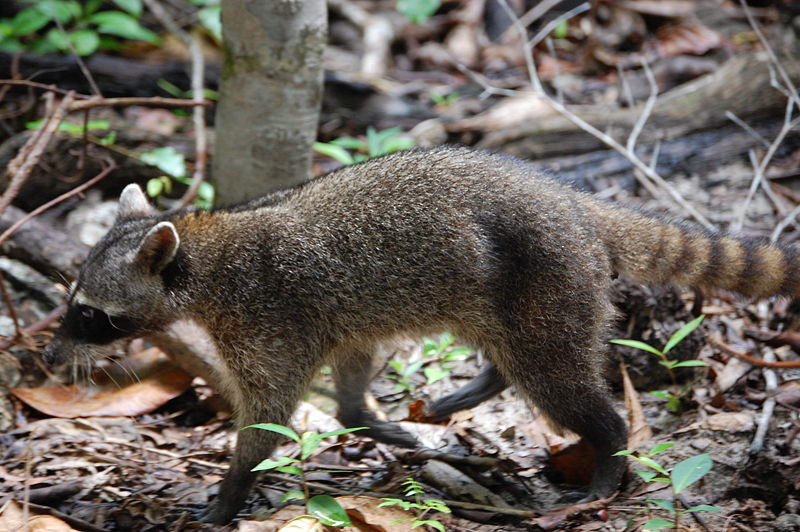
Other body parts aids carnivores to attain a very delicate sense of touch. Raccoons whiskers augment the animals need for a keen sense of smell. Also, these animals have sensitive nerve endings on the soles of their feet.

photo link

For small carnivores like the Coati (Nasua narica) of Central America, having to blend well with its surroundings is very essential for them to survive. The ability to change color (camouflage) will enable the animal to creep up on its prey unseen. Also, it serves as a defense mechanism to escape or free from harm from bigger predators.

photo link

An Individual Identity

Since almost all carnivores are gifted with an acute sense of smell marking out the boundaries of its territory will come in very helpful. These fearless animals emit special and identifiable scents and rub a certain part of its body against any object to mark out the scope of its territory. In some species, these foul-smelling scents serve as a defense mechanism against larger predators. Some species like the skunks and polecats produce these scents through glands in the skin.

photo link

Carnivores hunting style differs from species to species: lions go for ambush, cheetahs go for swift and stealthy pursuits and coyotes leap on prey.

photo link

But there is one carnivore species that has the most adaptable hunting skills. The crab - eating raccoon (Procyon cancrivorus) can climb well and swim well in pursuit of its prey. It lives in areas near marshes, rivers and lakes -- makes its home in the trees.

Check out Part 2 here:

Wednesday, June 1, 2011

Fascinating Animals Whose Names Begin with The Letter “C”

Natures present us with beautiful, strange, odd and fascinating creatures. The animal kingdom itself have millions of amazing and special species that many of us have not known or seen. Below is a list of 10 fascinating animals whose names begin with the letter C.

1. Capybara

photo link

A capybara is a semi-aquatic mammal that is native to South America. It is usually found living in forested areas near rivers, lakes, swamps, ponds and marshes. Capybara has short head and broad body with reddish-brown fur upper body that turns yellowish-brown underneath. On average, an adult capybara can reach 130 centimeters in length and to about 65 kg in weight.

Adult capybaras are tailless, have 20 teeth, and with slightly webbed feet. An herbivore, it feeds mainly on grass, fruits, tree bark sand aquatic plants. An adult capybara can consume up 3.5 kg of grass per day! Also, capybaras are excellent swimmers and can survive completely underwater for up to five minutes. If the need arises, it can sleep underwater, keeping its nose just at the waterline.

2. Cat

photo link

Our list would not be completed without the cat (Felis catus), also known as the domestic cat or housecat. A small predatory and carnivorous mammal, cats normally weigh between 2.5 and 7 kilograms and average about 23–25 centimeters in height. Cats' night vision is superior to humans and its sense of smell is about fourteen times as strong as a human's. Cats have dozens of movable vibrissae (whiskers) over their body, especially on theface that helps them in navigating.

3. Cuban Solenodon

photo link

The Cuban Solenodon, also known as Almiqui (Solenodon cubanus),is found in dense, humid forests, brush country, and around agricultural lands. A nocturnal mammal with dark brown fur, the Cuban solenodon has a flexible snout and tiny eyes. Adult ones average 41–56 cm long from nose to tail and weigh about one kg. A Cuban Solenodon communicates with others via squeaks, squeals and twitters. Its diet includes: snakes, frogs, and crabs.

4. Coconut Crab

photo link

The coconut crab (Birgus latro) also known as the robber crab or palm thief, is the largest land-living arthropod in the world. An excellent coconut palm climber, it can easily break open coconuts using powerful pair of pincers. Its body is divided into four regions; the cephalic lobe, forepart, trunk, and opisthosoma. Adults average up to 40 cm and weigh up to nine kg. Since coconut crabs live on the land, they have differently structured organs on their body that resembles those seen on insects. Coconut crabs main diet are coconuts, but they also search for fruits, leaves, tortoise eggs and even shells of other animals.

5. Coati

photo link

The coati is widespread and native to South, Central, and south-western North America. It lives in habitats ranging from hot and arid areas to humid Amazonian rainforests. A main feature of Coati is the white markings around the eyes, the ears and snout. Its snout is extremely flexible and can be rotated up to 60 degrees in any direction. Coatis average 33 to 69 cm from head to the base of the tail, about 30 cm tall at the shoulder, and weigh between three to eight kg. The coati is an omnivore; its diet consists mainly of ground litter invertebrates and fruits. They also eat small vertebrate prey, such as lizards, rodents, small birds, and bird's eggs.

6. Cheetah

photo link

The cheetah (Acinonyx jubatus) is the fastest land animal on earth, reaching speeds of up to 110 km/h (68 mph). Cheetahs are sprinters that can accelerate from 0 to 110 km/h (68 mph) in three seconds, faster than most super cars. A cheetah weighs between 88-143 pounds (39-65 kg). Its head and body together measure 44 to 53 inches (112-135 cm). The tail is 26 to 33 inches (66-84 cm).

7. Comb Jelly

photo link

The phylum Ctenophora, also known as Comb Jellies has about 90 extant species that live in marine waters worldwide. Their bodies consist of a mass of jelly with one layer of cells on the outside and another lining the internal cavity. Adults of various species range from a few millimeters to 1.5 meters (59 in) in size. Comb jellies use their eight rows of comb-like plates to move in a rippling motion. Most species use their two long tentacles to capture prey.

8. Crocodile

photo link

Crocodiles are large aquatic reptiles found throughout Africa, Asia, the Americas and Australia. Their habitat includes rivers, lakes, wetlands and sometimes in brackish water. Crocodiles have a streamlined body that enables them to swim swiftly. Webbed feet, which allow it to make fast turns and sudden moves in the water or initiate swimming. Crocodiles have the ability to close off their nasal passages in the water, allowing them to seize food without drowning. Since crocodiles feed by grabbing and holding on to their prey, they have evolved sharp teeth for tearing and holding on to flesh, and powerful muscles that close the jaws and holding them shut.

9. Caterpillar

photo link

Caterpillars are the larval stage of butterflies and moths. A voracious feeder, it eats leaves or other parts of plants. Most caterpillars have tubular, segmented bodies that includes: three pairs of true legs on the three thoracic segments, about four pairs of prolegs on the middle segments of the abdomen, and often a single pair of prolegs on the last abdominal segment. Caterpillars breathe through a series of small openings along the sides of their thorax and abdomen called spiracles. Caterpillars have 4,000 muscles and move through contraction of the muscles in the rear segments pushing the blood forward into the front segments elongating the torso. Many caterpillars are cryptically colored and resembled the plants on which they feed. Their size varies from as little as one mm to about three inches.

10. Clownfish

photo link

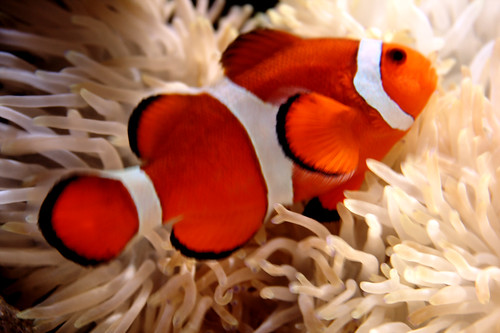
There are about twenty eight extant species of clownfish that are found in coral reefs in the Indian and Pacific oceans. Depending on species, clownfish are overall yellow, orange, reddish, or blackish, and many show white bars or patches. The largest reach a length of 18 cm, while the smallest barely reach 10 cm. They have a symbiotic relationship with sea anenomes. Clownfish secrete a special slime—thought to counteract the stinging cells of certain species of anemones—which enables them to seek refuge among anemone tentacles.

Check out the entire Animal Alphabet list here:
Amazing Animal Alphabet Series 1
Amazing Animal Alphabet Series 2