1. Capybara

A capybara is a semi-aquatic mammal that is native to South America. It is usually found living in forested areas near rivers, lakes, swamps, ponds and marshes. Capybara has short head and broad body with reddish-brown fur upper body that turns yellowish-brown underneath. On average, an adult capybara can reach 130 centimeters in length and to about 65 kg in weight.
Adult capybaras are tailless, have 20 teeth, and with slightly webbed feet. An herbivore, it feeds mainly on grass, fruits, tree bark sand aquatic plants. An adult capybara can consume up 3.5 kg of grass per day! Also, capybaras are excellent swimmers and can survive completely underwater for up to five minutes. If the need arises, it can sleep underwater, keeping its nose just at the waterline.
2. Cat

Our list would not be completed without the cat (Felis catus), also known as the domestic cat or housecat. A small predatory and carnivorous mammal, cats normally weigh between 2.5 and 7 kilograms and average about 23–25 centimeters in height. Cats' night vision is superior to humans and its sense of smell is about fourteen times as strong as a human's. Cats have dozens of movable vibrissae (whiskers) over their body, especially on theface that helps them in navigating.
3. Cuban Solenodon

The Cuban Solenodon, also known as Almiqui (Solenodon cubanus),is found in dense, humid forests, brush country, and around agricultural lands. A nocturnal mammal with dark brown fur, the Cuban solenodon has a flexible snout and tiny eyes. Adult ones average 41–56 cm long from nose to tail and weigh about one kg. A Cuban Solenodon communicates with others via squeaks, squeals and twitters. Its diet includes: snakes, frogs, and crabs.
4. Coconut Crab

The coconut crab (Birgus latro) also known as the robber crab or palm thief, is the largest land-living arthropod in the world. An excellent coconut palm climber, it can easily break open coconuts using powerful pair of pincers. Its body is divided into four regions; the cephalic lobe, forepart, trunk, and opisthosoma. Adults average up to 40 cm and weigh up to nine kg. Since coconut crabs live on the land, they have differently structured organs on their body that resembles those seen on insects. Coconut crabs main diet are coconuts, but they also search for fruits, leaves, tortoise eggs and even shells of other animals.
5. Coati

The coati is widespread and native to South, Central, and south-western North America. It lives in habitats ranging from hot and arid areas to humid Amazonian rainforests. A main feature of Coati is the white markings around the eyes, the ears and snout. Its snout is extremely flexible and can be rotated up to 60 degrees in any direction. Coatis average 33 to 69 cm from head to the base of the tail, about 30 cm tall at the shoulder, and weigh between three to eight kg. The coati is an omnivore; its diet consists mainly of ground litter invertebrates and fruits. They also eat small vertebrate prey, such as lizards, rodents, small birds, and bird's eggs.
6. Cheetah

The cheetah (Acinonyx jubatus) is the fastest land animal on earth, reaching speeds of up to 110 km/h (68 mph). Cheetahs are sprinters that can accelerate from 0 to 110 km/h (68 mph) in three seconds, faster than most super cars. A cheetah weighs between 88-143 pounds (39-65 kg). Its head and body together measure 44 to 53 inches (112-135 cm). The tail is 26 to 33 inches (66-84 cm).
7. Comb Jelly

The phylum Ctenophora, also known as Comb Jellies has about 90 extant species that live in marine waters worldwide. Their bodies consist of a mass of jelly with one layer of cells on the outside and another lining the internal cavity. Adults of various species range from a few millimeters to 1.5 meters (59 in) in size. Comb jellies use their eight rows of comb-like plates to move in a rippling motion. Most species use their two long tentacles to capture prey.
8. Crocodile

Crocodiles are large aquatic reptiles found throughout Africa, Asia, the Americas and Australia. Their habitat includes rivers, lakes, wetlands and sometimes in brackish water. Crocodiles have a streamlined body that enables them to swim swiftly. Webbed feet, which allow it to make fast turns and sudden moves in the water or initiate swimming. Crocodiles have the ability to close off their nasal passages in the water, allowing them to seize food without drowning. Since crocodiles feed by grabbing and holding on to their prey, they have evolved sharp teeth for tearing and holding on to flesh, and powerful muscles that close the jaws and holding them shut.
9. Caterpillar

Caterpillars are the larval stage of butterflies and moths. A voracious feeder, it eats leaves or other parts of plants. Most caterpillars have tubular, segmented bodies that includes: three pairs of true legs on the three thoracic segments, about four pairs of prolegs on the middle segments of the abdomen, and often a single pair of prolegs on the last abdominal segment. Caterpillars breathe through a series of small openings along the sides of their thorax and abdomen called spiracles. Caterpillars have 4,000 muscles and move through contraction of the muscles in the rear segments pushing the blood forward into the front segments elongating the torso. Many caterpillars are cryptically colored and resembled the plants on which they feed. Their size varies from as little as one mm to about three inches.

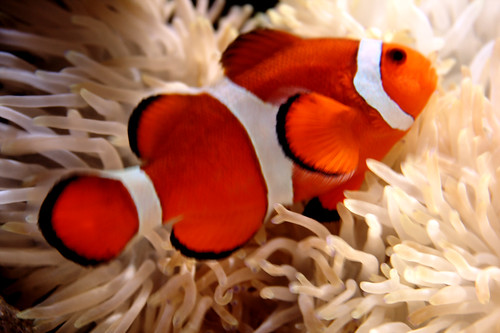
There are about twenty eight extant species of clownfish that are found in coral reefs in the Indian and Pacific oceans. Depending on species, clownfish are overall yellow, orange, reddish, or blackish, and many show white bars or patches. The largest reach a length of 18 cm, while the smallest barely reach 10 cm. They have a symbiotic relationship with sea anenomes. Clownfish secrete a special slime—thought to counteract the stinging cells of certain species of anemones—which enables them to seek refuge among anemone tentacles.
Check out the entire Animal Alphabet list here:
Amazing Animal Alphabet Series 1
Amazing Animal Alphabet Series 2