
The color blue is found in many different species of birds - big or small. Here are 10 fascinating blue colored birds that can be a good addition to your private aviary.
Blue Bunting

Blue Buntings (Cyanocompsa parellina) are small, stocky brightly colored bird found along coastal regions in Mexico and northern areas of Central America. It inhabits thickets and woodland from sea level to about 1800 meters.
The males are deep blue overall with black face and milky blue fore-crown. The species wear heavy, rounded, black bill with wings pulled briefly to sides. Females are uniformly brown with a gray bill. This passerine bird measures 14 cm (5.5 inches) in length with a wingspan of 22 cm 8.5 inches (8.5 inches).
Mexican Jay
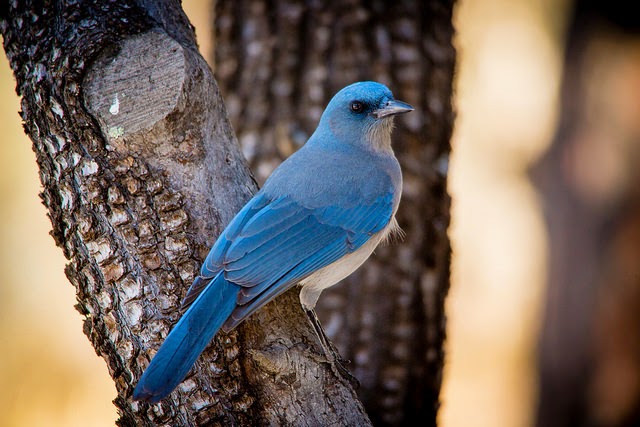
Mexican Jay (Aphelocoma wollweberi) is a large, crestless songbird with blue head, wings and tail. It has grayish blue back, black bill and legs. Juvenile all dull gray, with pale bill.
The species lives in the oak woodlands of western Texas, New Mexico, and Arizona. It lives in social groups and forages on the ground or in trees. Its diet includes acorns, fruit, carrion and eggs.
Indian Peafowl

The Indian Peafowl or Blue Peafowl (Pavo cristatus) is a large peacock native to South Asia. Males are predominantly blue with glossy iridescent blue head, neck and breast adorn with a fan-shaped crest of spatula-tipped wire-like feathers. Females lack the train, and have a greenish lower neck and light brown plumage.
Males measure around 100 to 115 cm (40 to 46 inches) from bill to tail of 100 to 115 cm (40 to 46 inches) and weigh 4–6 kg (8.8–13.2 lbs). The females, or peahens, are smaller at around 95 cm (38 inches) in length and weigh 2.75–4 kg (6–8.8 lbs). Indian peafowl Feeds on seeds and insects.
Mountain Bluebird
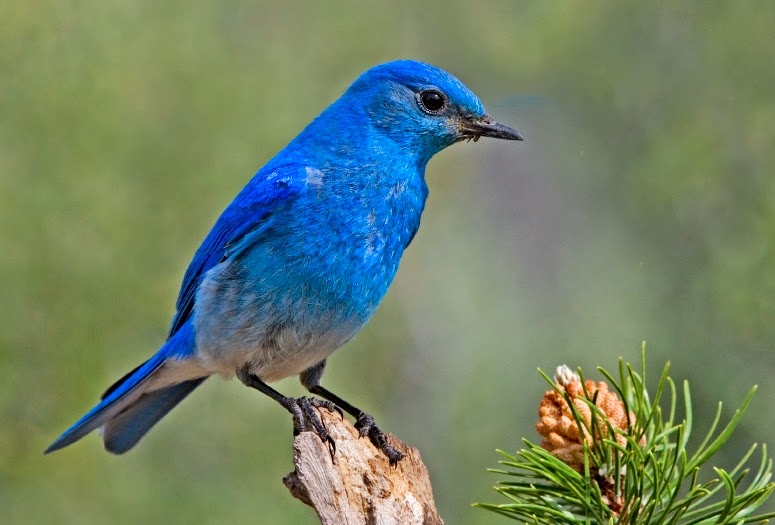
The Mountain Bluebird (Sialia currucoides) is a medium-sized bird measuring around 16–20 cm (6.3–7.9 in) and weighing about 30 g (1.1 oz). Adult males have brilliant blue back, head, and wings. They have paler blue throat, light underbellies and black eyes. Adult females are mostly gray-brown with thin bills, duller blue wings and tail; grey crown, grey breast, throat and back.
Hyacinth Macaw

The Hyacinth Macaw (Anodorhynchus hyacinthinus) is the largest parrot by length in the world. The species is native to central and eastern South America. It measures about 30 to 100 cm (11.8 to 39.5 in)(from the top of its head to the tip of its long pointed tail.) It weighs around 129 to 1,695 g (4.5 oz to 3.75 lbs.)
Its feathers are entirely blue, lighter above. The Hyacinth Macaw is found mainly in riverside topical rain forest and palm swamps. Its diet includes seeds, nuts, fruits, and vegetable parts.
Belted Kingfisher

The Belted Kingfisher (Megaceryle alcyon) is medium-sized water kingfisher found in the northern United States and Canada. It has a large head, bushy crest, white collar and large, black dagger-like bill. Further, belted kingfisher has blue-gray upperparts, white underparts and gray legs and feet.
This blue beauty measures between 28–35 cm (11–14 in) long with a wingspan of between 48–58 cm (19–23 in). It can weigh from 113 to 178 g (4.0 to 6.3 oz).
Black-throated Blue Warbler

The Black-throated Blue Warbler (Setophaga caerulescens) is a small warbler that breeds in North America and winters in the Caribbean. The species measures 13 cm (5.1 in) in length and weighs 8.4–12.4 g (0.30–0.44 oz).
The adult male has black face, cheeks and throat and white wings. Bill, legs and feet are black. It has Dark blue upperparts and White underparts with black sides. The female is olive-brown.
Indigo Bunting

The Indigo Bunting (Passerina cyanea) is a small,beautiful songbird easily recognize by its brilliant, almost iridescent, blue plumage. Wings and tail are black with blue edges. Crown is darker blue with a purple tint. It measures 11.5–13 cm (4.5–5.1 in) in length.
Males display vibrant blue plumage in the summer and a brown color during the winter months. Females are typically brown with light brown beak tinged with blue. The diet of the indigo bunting includes insects, larvae, grains, and seeds.
Great Blue Heron

The Great Blue Heron (Ardea herodias) is the largest North American heron. It measures from 91–137 cm (36–54 in) head-to-tail length , around 167–201 cm (66–79 in) wing span, and around 1.82–3.6 kg (4.0–7.9 lb)in weight. This wading bird inhabits marshes, salt water shores, rivers, lakes, and ponds.
It is has blue-gray body and gray with a slight azure blue flight feathers. It has dull gray-yellow bill, black plumes above their eyes and long yellow legs and neck.
Blue Jay

The Blue Jay (Cyanocitta cristata) is a medium, noisy, passerine bird native to North America. These white-faced birds inhabit all kinds of forests but especially near oak trees. It measures 22–30 cm (9–12 in) from bill to tail and weighs 70–100 g (2.5–3.5 oz), with a wingspan of 34–43 cm (13–17 in).
The species has a distinctive blue crest, back, wings and tail. The eyes are also black, heavy bill, a black, U-shaped collar around its neck and white chest and underparts Males and females are almost identical, but the male is slightly larger.


