'/> Amazing Animals: Aardvark
Showing posts with label Aardvark. Show all posts

Thursday, February 9, 2012

The World’s 10 Most Fearless Ants and Termites Hunters

These uncanny hunters, sport outwardly bizarre-looking features and go for a special diet – ants and termites. And through the course of time, ants and termites tremble to death just seeing their faces. Why? For these 10 fearless hunters have perfected the art of ant-eating! Read on to meet The World’s 10 Most Fearless Ant and Termites Hunters.

What do the Giant Armadillo, Echidna, Aardvark, Numbat, Silky Anteater, and Numbat have in common. These fearless hunters are known as “ants and termites” terminators.

Giant Anteater

photo link

The Giant Anteater (Myrmecophaga pterodactyl), the largest species of anteater, is native to Central and South America. Its habitat includes swamps, grassland savannahs, woodlands and humid forests. It grows to about 2.1 m (7 ft) long, with a 0.91 m (3-ft) long bushy tail. An adult can weigh from 29 to 64 kg (65 to 140 pounds). A giant anteater has tapered head, small eyes, long nose and round ears. Its coarse, straw-like hair may be gray or brown, which grows up to 40 cm long on the tail.

Silky Anteater

photo link

The Silky Anteater or Pygmy Anteater (Cyclopes didactylus) is the smallest member of the anteater found in the tropical forests of Central and South America. It can usually be found high up in trees, especially in Ceiba (silk cotton) trees. It grows from 32 to 52 cm (12 to 21 in) in length and weighs from 175 to 500 g. This nocturnal and arboreal animal have soft golden brown or gray fur with a brown stripe on the back. It has a short pink snout, a long tongue, prehensile tail, and has two toes with curved claws on each of its front feet. The silky Anteater is a slow-moving animal, but can consume between 100 and 8000 ants a day. It also feeds on other insects like beetles.

Northern Tamandua

photo link

The Northern Tamandua (Tamandua Mexicana) or Lesser anteater, is endemic to tropical and subtropical forests from southern Mexico, through Central America, and to the coastal forests of Ecuador and Peru. It is a medium-sized anteater which grows to about 130 cm (50 in) long including the long, hairless prehensile tail. Adults weigh between 3.2 to 5.4 kilograms (7.1 to 12 lbs). It has pale yellow to off-white fur mark with a distinctive “sweater vest” patch of deep black. It has small eyes and ears, and a long snout. Though lacking in teeth, it has long, extensible, and sticky tongue used to catch ants and termites. It can live up to 16 years in the wild.

Southern Tamandua

photo link

The Southern Tamandua (Tamandua tetradactyla), also called the Collared Anteater or Lesser Anteater, is a medium-sized anteater found in high altitude rainforests and savannas of South America. Generally, it has brown to tan fur with black patch resembling a vest running across its shoulder down to the back and sides. This mammal has four sharply clawed toes on their front feet and five toes on its back limbs. Adults Southern Tamanduas grow from 535 mm to 880 mm (21.1 in to 31.5 in) long with a 400 mm to 590 mm (15.7 in to 23.2 in) long prehensile tail. It has small eyes and poor vision but good sense of smell used to track down ants and termites. It also feeds on bees and honey.

Giant Armadillo

photo link

The Giant Armadillo (Priodontes maximus)is the largest extant species of armadillo found in South America. It lives in burrows near water , woodland, grassland, and forest habitats. This solitary and nocturnal animal measures from 13 to 150 cm (5 to 59 in) long and weighs about 85 g to 54 kg (3 oz to 120 lbs). Overall, it is dark brown in color, except for the head, tail and under part of the shell, which are nearly white. Its neck and body is protected with 14 to 17 moveable bands.

The giant armadillo has around 80 to 100 teeth and also possesses very long front claws. An omnivore, it primarily feeds on ants and termites and has been known to hunt upon spiders, worms, snakes, and plants. Giant armadillos can live 12 to 15 years. It is classified as Vulnerable (VU) on the IUCN Red List.>

Pink Fairy Armadillo

photo link

Just 90–115 mm (3.5 to 4.5 inches) long excluding the tail, the Pink Fairy Armadillo (Chlamyphorus truncatus) or pichiciego is the smallest species of armadillo. An endangered species, it is native to Argentina and generally inhabits dry grassland areas. It is pale rose or pink in color and possesses armored back plates.

What is unique about this animal is that it is the only armadillo whose dorsal shell is almost completely separated from the body. It is a nocturnal animal, which spends much of its time in underground burrows. A fearless ants and termites hunter, it occasionally feeds on insects and larvae, worms, snails, as well as small plants.

Aardvark

photo link

The Aardvark (Orycteropus afer), meaning “Earth Pig”, is a medium-sized, pig-like mammal native to Africa. It has a stout body with a pale, yellowish-gray colored skin. Its back is slightly arched and covered with coarse hairs. The head is elongated, the ears are long, the mouth is tube-shaped and the tongue is extremely long and thin. On average, Aardvark measures between 1 to 1.3 m (3.3 to 4.3 ft) with a tail which can reach to 70 cm (28 in) long. It weighs about 40 and 65 kg (88 and 140 lbs). A solitary and nocturnal animal, it feeds primarily on ants and termites.

Numbat

photo link

The Numbat (Myrmecobius fasciatus) or Banded Anteater is a day-active marsupial endemic to Western Australia. It is a small carnivorous animal between 35 and 45 cm (13-18″) long and weighs 280 and 550 grams. This colorful creature varies in color from soft grey to reddish-brown, with a contrasting black stripe running from its lower back and rump. It sports a pointed muzzle, small, round-tipped ears and a distinctive bushy tail.

Numbat has a long, sticky tongue for eating ants and termites

Echidna

photo link

The Echidna, or Spiny Anteater, along with the Platypus, are the only egg-laying mammals (monotremes). Native to Australia and New Guinea, it is a small, nocturnal animal between 35 – 45 cm long and weighs between 2-7 kg. Its body is covered with a “normal” short, coarse hair and long spines. It has a small mouth, a pointed snout and a long sticky tongue. The echidna has a very short, flat limbs with long, powerful, curved claws used in tearing open anthills. It then uses its long, sticky tongue to collect its prey, which primarily are ants and termites, though some species also eat worms and insect larvae.

Pangolin

photo link

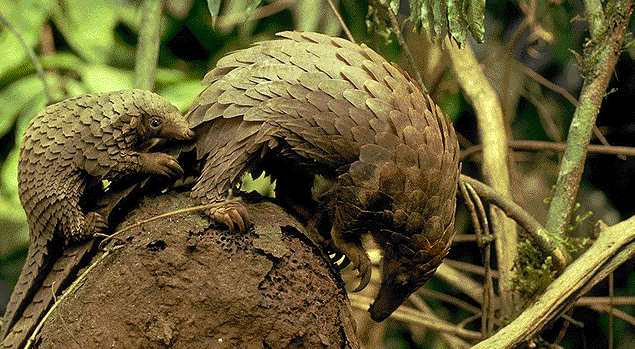
The Pangolin or Scaly Anteater is a weird-looking animal found in Southeast Asia and Africa. Its skin is covered by large, razor-sharp, plate-like keratin scales. Depending on the species, the Pangolin measures from 30 cm to 100 cm (12 to 39 inches). This solitary and nocturnal mammal has short legs with long, sharp front claws used for digging into termite mounds and anthills. It then uses its extremely long tongue to collect its meal. Pangolin has a life span of up to twenty years in captivity.

Thursday, December 15, 2011

10 Amazing Mammals Considered as Living Fossils

From a rabbit-like deer to a giraffe-like mammal, this is a list of 10 amazing mammals, scientists considered as ‘living fossils.

'Living fossils' are plants or animals that were once known to have been extinct for millions of years. But then, survived the test of time and are now found to be alive. Read on to know 10 amazing mammals, scientists consider as ‘living fossil’.

Aardvark

photo link

Aardvarks (Orycteropus afer), also called “antbears,” is endemic throughout sub-Saharan Africa. Genetically speaking, this burrowing animal resembling a pig is a living fossil, since it is the only extant representative of the order Tubulidentata. Its nearest relative is the elephant shrew. Aside from the pig-like body and a long snout, the Aardvark manifests other weird features–a kangaroo tail, a long sticky tongue and rabbit-like ears.

A solitary and nocturnal animal, it inhabits grasslands, savannahs and woodlands. It feeds mostly on ants and termites. Sporting a thin Yellowish/Gray/ Brown coat, adult ones measure between 109 to 135 cm in body length , around 50 to 82 kg in weight and about and 53 to 66 cm tall. Aardvark can live up to 23 years in captivity.

Amami Rabbit

photo link

The only species in its genus, the Amami Rabbit(Pentalagus furnessi), also called as the Ryukyu Rabbit, is found only in Amami Ìshima and Toku-no-Shima, two small islands of Japan. This primitive dark-furred rabbit, called a living fossil, because its physical characteristics resemble those of prehistoric rabbits living during the Miocene age.

The Amami Rabbit has a bulky body, small eyes and ears, short limbs, a long snout and large, curved claws. This forest-dweller has dense and wooly fur that is dark-brown in color, mark with reddish-brown underbelly. It measures between 430-510 mm long and around 2 kg in weight. The Amami Rabbit’s diet includes berries, bamboo shoots, acorn, leaves and stem of sweet potatoes. As a result of rampant hunting, this ancient rabbit is Classified as Endangered on the 2010 IUCN Red List of Threatened Species.

Chevrotain

photo link

Chevrotain, also called mouse deer, is any of 10 extant species of small, hoofed mammals found in Africa and SE Asia. These living fossils of primitive ruminant mammals are classified under the family Tragulidae (order Artiodactyla). All species lack horns, but have strong upper canine teeth. They sport reddish-brown coat mark with white spots. Depending on the species, chevrotains measure between 20 -50 cm at the shoulder, and weigh between 0.7-16 kg.

They have rabbit-like body, arched back and very slender legs. They are solitary and nocturnal mammals that feed on leaves, twigs and fruits of plants. However, the African water chevrotain (Hyemoschus aquaticus), occasionally feed on insects, crabs, and fish.

Elephant shrew

photo link

Elephant shrews, also called jumping shrews, are small mouse-like mammals indigenous to Africa, comprising the family Macroscelididae, in the order Macroscelidea. These living fossils are not related to the true shrew and recent studies suggests that they are more related to golden moles, aadvarks, hydraxes and elephants. These primitive mammals have elephant-like long noses and the trunk, large canine teeth, long legs and short mouse-like tails.

Elephant shrews measure between 10-30 cm and weigh from 50-500 g, depending on the species. Colors vary from brown to gray to a combination of the two. The Elephant shrews diet includes: insects, earthworm, spiders, centipedes, and millipedes. Some species also consume leaves, fruits and seeds.

Koala

photo link

The Koala (Phascolarctos cinereus)is a cute and amazing mammal native to Australia, and the only living species of the family Phascolarctidae. These herbivorous marsupials might have originated from wombat-like animals (its closest living relative). These arboreal and placid bear-like animals are active only for 3-5 hours a day, which they mostly used feeding on eucalyptus leaves.

Koala has a flat nose, big ears and ash-grey thick furred coat, with white markings on the chest. Koalas of the southern regions which are larger than the northern ones average 78 cm (males) and 8 kg (males). Koalas can live between 13-18 years.

Iriomote cat

photo link

The Iriomote cat (Prionailurus iriomotensis), is a wild cat considered a “living fossil” that is only found on the Japanese island of Iriomote. Discovered in 1965, this endangered species of cat have dark brown fur with dark stripes around the neck, elongated body, short legs and a bushy tail. A solitary but excellent hunter, it measures 48 cm in body length, 25 cm at shoulder height and weighs between 3–7 kg. It feeds on rats, bats, snakes, birds, lizards, frogs and insects. With barely 100 individuals left, the Iriomote cat is listed as Critically Endangered by The International Union for the Conservation of Nature and Natural Resources (IUCN).

Monito del Monte

photo link

Regarded by scientists as a living fossil, the Monito del Monte (Dromiciops gliroides) or “mountain monkey”, a small marsupial is the only surviving representative of the superorder Australidelphia. A nocturnal and arboreal mammal, it is widespread across Argentina and Chile inhabiting dense, cool, humid forests. Slightly larger than a mouse, it measures between 83-130mm (head to body) length, around 90-132 mm tall and weighs between 16-42 g.

It has dense, silky brown-colored fur, short and furry ears, round eyes mark by black rings and a hairy prehensile tail. An amazing and excellent tree climber, it feeds mainly on insects and other small invertebrates. The Monito del Monte has a life span of about 2 years. Its population decreasing due to habitat loss, this marsupial is Listed as Vulnerable on the 2006 IUCN Red List of Threatened Species.

Okapi

photo link

The okapi (Okapia johnstoni), is another amazing ’living fossil’, resembling a zebra, but is more closely related to the giraffe. Currently numbering about 10,000–20,000 in the wild, Okapis are native to the Ituri Rainforest, in the Democratic Republic of the Congo, in Central Africa. On average, they measure between 1.9 – 2.5 m long, stand 1.5 – 2.0 m at the shoulder and weigh between 200 – 300 kilograms.

These giraffe-like mammals have reddish-brown coat mark with horizontal white stripes on their legs. They have large ears and a 14 inch bluish grey tongue. A solitary, diurnal mammal, okapis feed on tree leaves and shoots, fruits, ferns and grass.

Red Panda

photo link

The red panda (Ailurus fulgens), the only living representative of the genus Ailurus, is a small tree-dwelling mammal found in China, Myanmar, Nepal, and Bhutan. Red panda is just about the size of a domestic cat, measuring between 50 to 65 cm in head to body length, and weighing around 5.4 to 9 kg.

It has soft reddish-brown fur, a cat-like whiskers, and a hairy tail reaching 30 to 50 cm long. A shy, solitary but excellent tree climber, it feeds mainly on bamboos but may also consume insects, birds, eggs, and other small mammals. Its population declining cause by habitat loss and poaching, the red panda is now endangered.

Giant Panda

photo link

The giant panda (Ailuropoda melanoleuca), is a bear native to central China, which inhabits high altitude bamboo-rich coniferous forests. These amazing ‘living fossils’ can easily be recognized by the large, unique black patches surrounding the eyes and across its round body. A terrestrial animal, it feed primarily on bamboos and occasionally wild tubers and grasses.

Adult pandas measure between 1.2 to 1.8 m long, around 75 cm tall at the shoulder, and can weigh up to 150 kilograms. The tail can measure 10 to 15 centimeters. In the wild, pandas can live up 20 years and up to 30 years in captivity. Due to habitat loss and other development, the panda is now an endangered species